

CIMA Certificate in Accounting and Finance
BPP University
2012
Instructor
Ken Chigbo is an instructor at SimFi University. He is a macro trader and market analyst with close to two decades of experience in financial markets. His teaching shows traders how economic conditions, central bank policy and interest rates move markets. It then shows them how to turn that understanding into a defined, risk-managed trade.
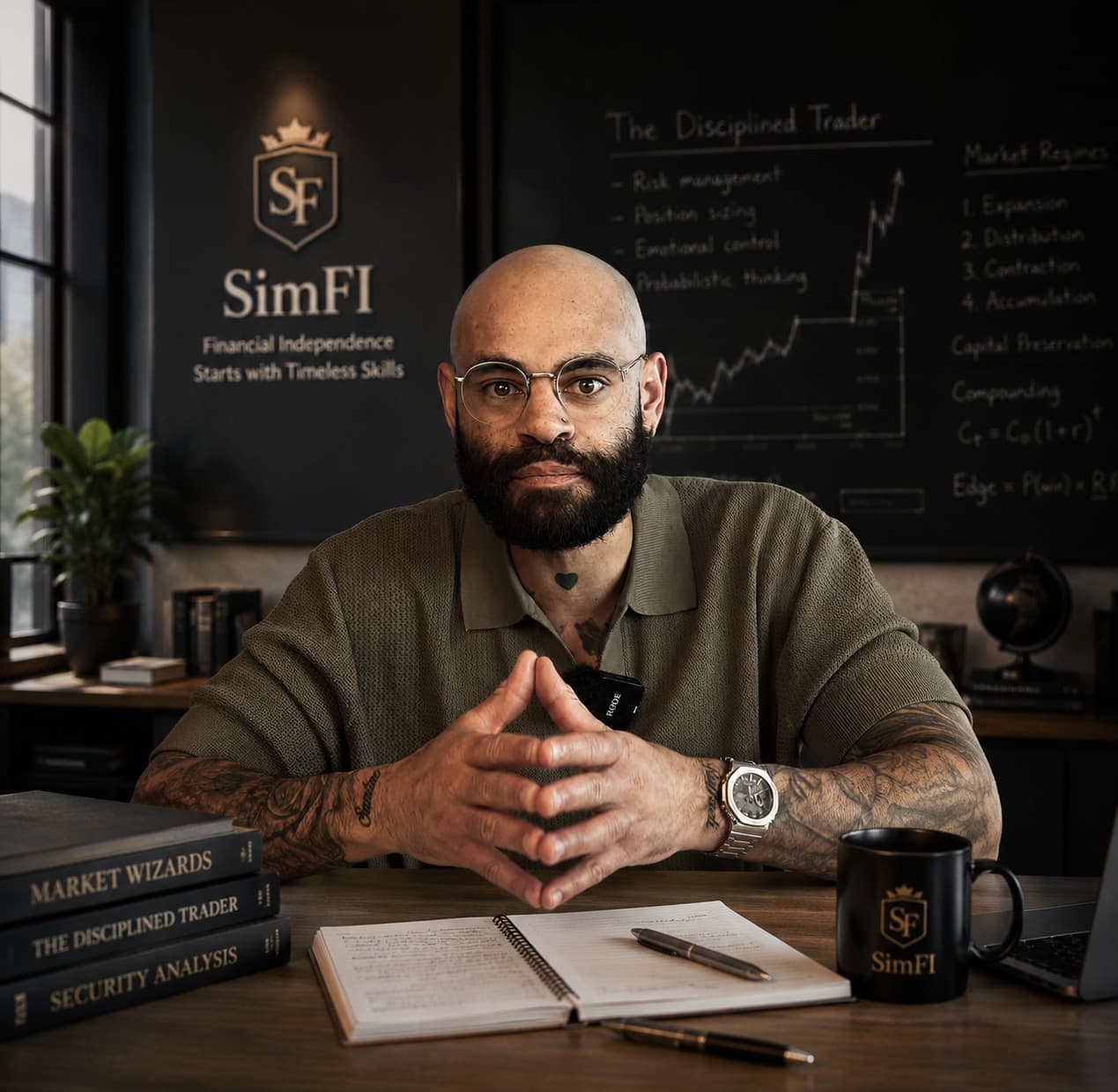
Like each SimFi instructor, Ken contributes to the University's curriculum from the standpoint of active practice. His contribution is macro: he connects what learners study about markets to the economic forces that move prices. The aim is not to hand learners a view to follow. It is to help them build their own framework for making decisions.
Ken has worked in financial markets from several sides. He began in a trading floor environment in the City of London. He then moved into analyst roles covering foreign exchange, fixed income, commodities and equities.
He later spent around eight years in corporate roles, including corporate foreign exchange. There he helped businesses:
Ken has traded independently since 2017, with a focus on foreign exchange, gold and the macro factors that drive them.
His teaching rests on one order of work: understand the environment first, then look for the trade. Many traders start with a chart and look for a reason for the move afterward. He reverses that sequence. The learner studies the forces acting on a market, forms a view, sets out scenarios, and only then uses technical analysis to time and define the trade.
Ken stresses that an economic release is not the trade in itself. What matters more is what the release changes: expectations, interest rates, bond yields, currencies and, in the end, price. Macro analysis supplies the reason for a trade, and technical analysis supplies the execution.
His instruction covers:
His path into markets was gradual. At 16 he worked as a tea boy on a trading floor during school holidays. That early exposure led to analyst and macro analysis roles, and from there to corporate foreign exchange. In corporate foreign exchange, currency risk was a business problem with real consequences, not an abstract one.
After roughly eight years in corporate roles, he chose to apply that experience to his own trading. He has taught traders internationally since 2016, with a particular focus on making macroeconomics practical for independent traders.
This background explains why Ken does not separate technical trading from the economic environment around it. His approach asks four questions in turn: why a market is moving, what information has changed, how related assets are responding, and where the actual trading opportunity lies.
BPP University
2012
Since 2016 he has taught traders internationally. His focus is on translating economic information, central bank policy, rates and yields into practical trading decisions.
FXStreet
2018–2020
Contributing writer on currency and macro markets
Hacked
2018–2020
Contributing writer on currency and macro markets
Podcast
Discussed his path from the trading floor to independent practice
The Trader Score is an independent measure of trading behavior across six families. It does not measure profit. The activity it reflects takes place on simulated capital.
Institutions and organizations are named on this page to identify the instructor's professional history. Their mention does not imply endorsement of SimFi University by those institutions, nor any accreditation of SimFi University. This page describes professional experience. It does not report trading results, and the Trader Score shown measures behavior, not profit.